

An Audience Reacts
How Groundhog Day Creates a Character Arc (Without Backstory)
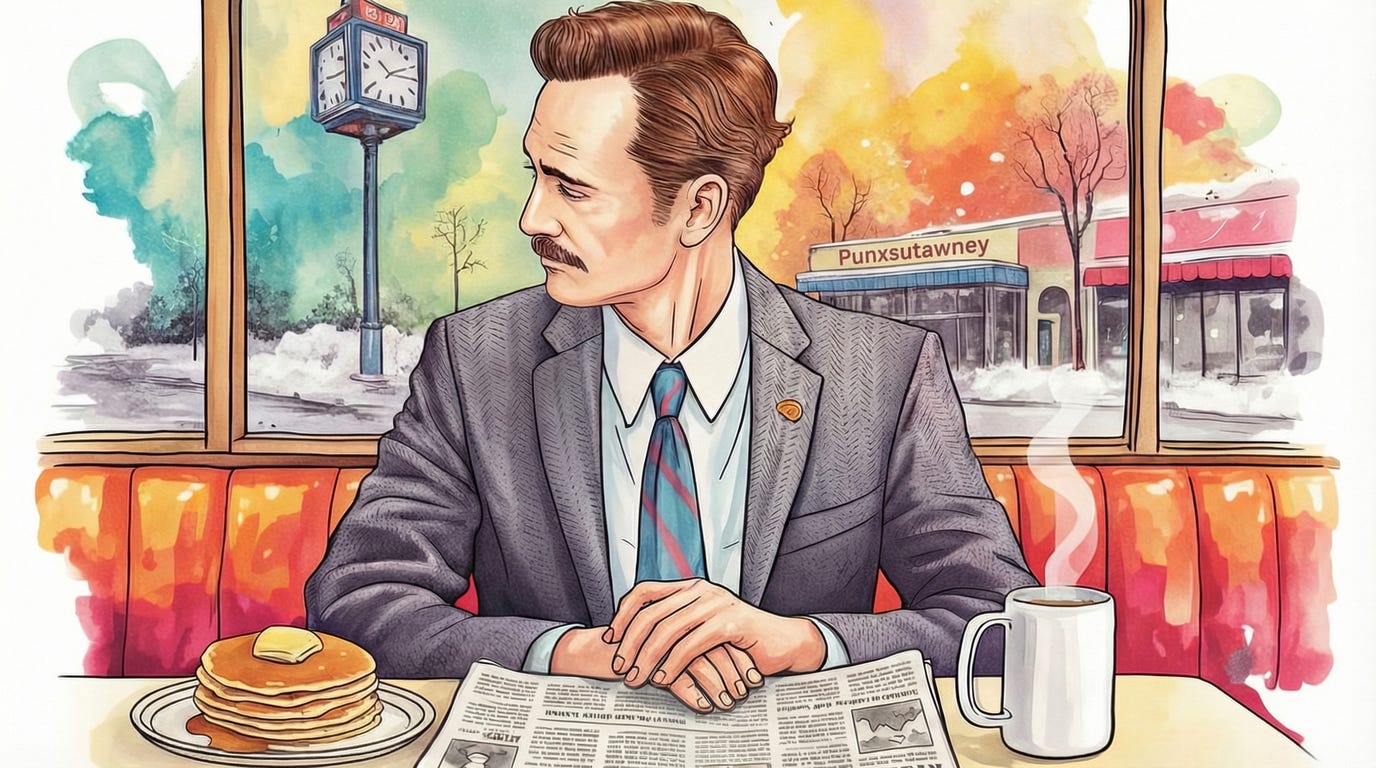
This week we celebrated Groundhog Day in the US. I streamed “reaction videos” because I’m a mindless slave to the algorithm. Random YouTubers were watching the movie Groundhog Day to get a boost from the holiday tie-in, and I pulled up to the slop trough to consume each react video the algorithm suggested. It was Groundhog Day all over again.
While watching reactions to the movie I noticed something odd. Viewers loved the character arc—it was 10/10. And yet, I couldn’t remember many details about the backstory. So I watched again, listening for any facts that described Bill Murray’s character. Who is Phil Connors? Here is everything we know. He’s a weatherman from Pittsburgh. His sister once dated Ned (now an insurance salesman) until Phil chased him off. And, that’s it. That is Phil’s backstory in the movie. He has no past trauma to process. He doesn’t talk about feelings. We don’t know if his mother abandoned him as a child. When Rita, his love interest, asks Phil about himself, he deflects. His most honest moment comes when he says, “I don’t even like myself.”
This runs counter to so much advice we’re given as writers. We’re told that character is about psychology, trauma, and backstory. We’re instructed to flesh out the biographic data before we start to write.
And yet, we all know who Phil is at the start of the movie, a dollop of Bill Murray’s charm mixed in with the arrogance of his big city character. There’s a lot of agreement about his character in the react videos: rude, prima donna, narcissist, mean, tiresome, and toxic (but also likable and snarky). Phil says things so self-centered and egotistical the audience cheers when he’s smacked in the head by a snow shovel. Everyone agrees he deserves a bite of cosmic karma.
So if backstory is lacking, how do we learn about Phil’s character and chart his transformation?
Actions: (1) In our first glimpse of Phil he stands in front of an empty blue screen blowing a CGI snowstorm away. (2) Later, he kidnaps a woodchuck and lets it drive a truck off a cliff, and (3) by the end of the movie he’s changing flat tires and performing jazz on stage.
Inaction: (1) Early in the movie Phil turns down an invitation to dinner. (2) Later after the time loop starts he walks away from the broadcast. (3) By the end he stops trying to impress Rita.
Interactions: (1) Phil makes fun of Rita’s groundhog impression and belittles the camera man. (2) Later in the movie, he pretends to be Rita’s perfect man by mirroring her preferences. (3) By the end he’s embracing Ned Ryerson and treating the most annoying man in the town—an insurance salesman—as a friend.
Reactions: (1) Phil reacts to the people around him with disdain, referring to the people of Punxsutawny as hicks and morons. (2) Later he reacts to them as NPCs in his god-mode game. (3) And finally, not only does he react to the townspeople as friends, they react to him as the most popular man in town.
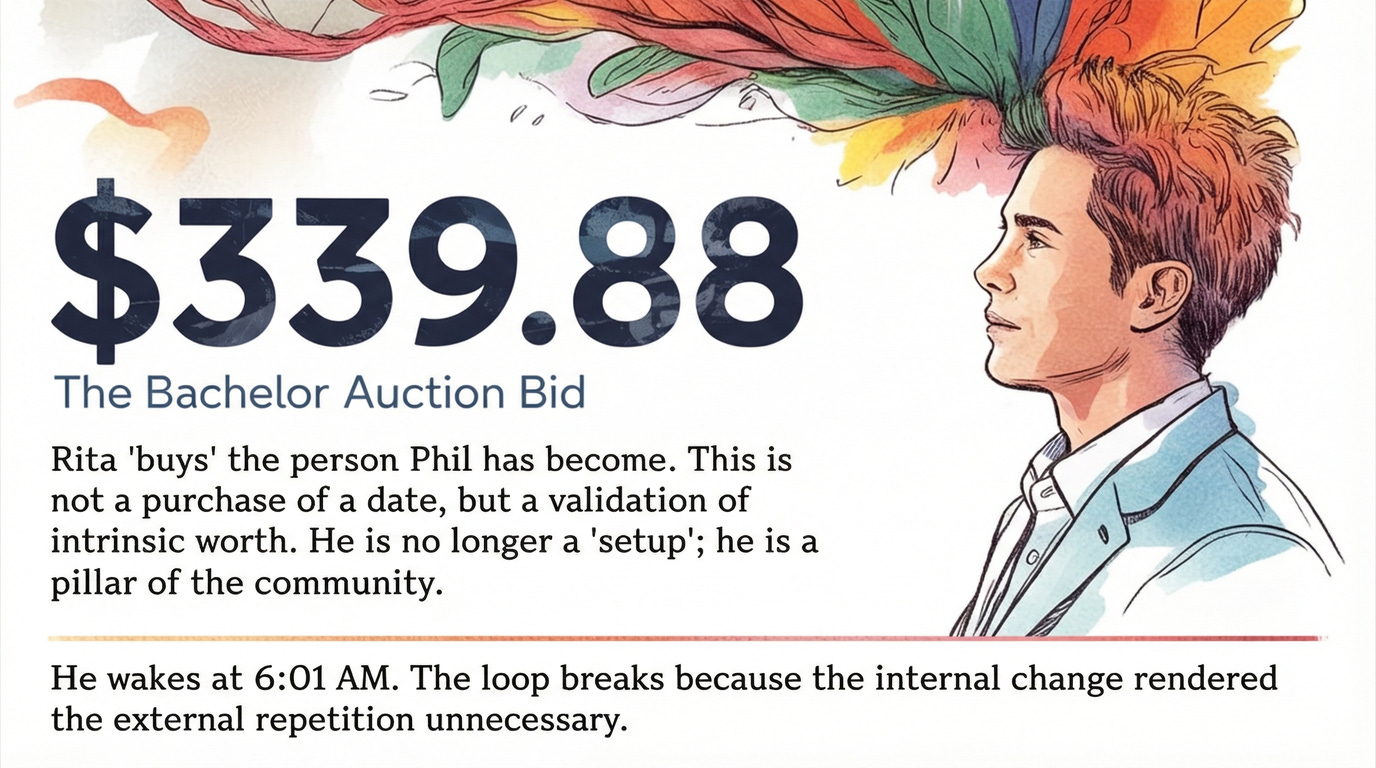
This last piece is important. Reactions are the essence of a story. Rita doesn’t just base her knowledge of Phil based on her interactions with him. In one of the loops, Phil gives her a perfect day, but she still sees through his act. His actions alone are not enough evidence to overcome his past bad impressions. In the final loop, it’s the townspeople and their reactions that convince Rita that Phil is a good man. Then, the audience themselves use Rita’s reaction to Phil as their measure of his worth—$339.88, the price she pays for him at the charity auction.
Once Rita fully embraces the man Phil has become, the audience is ready for the time loop (and the movie) to end. When it seems like he’s still stuck in the loop, the audience groans and complains. Then they realize the curse is broken and the cheers start.
Consider this. Why was I even watching random YouTubers react to a movie I’ve seen many times before? Part of the reason is my instinct as a writer. React videos are a goldmine of data about audiences and how they experience a story. But that’s more of an excuse. At a basic level, I like to watch people react to other people. It’s a social instinct. I learn what it means to be a good man by watching how people react to the many versions of Phil Connors.
As a quick contrast, this week I also watched reactions to Star Trek Picard, a show that is on my Do Not Watch list. There’s a scene in season two where the character Raffi says, “What I’m feeling right now is intense shock.” I had to pause and replay that line a couple times because I could not believe I heard the line right. Her friend has just died, and she blames Picard. Her response is to talk about her feelings. The audience's reaction to this dialogue is just as confused as my own reaction. A person in shock does not angrily articulate their feelings. In the scene the character looks and sounds angry. She talks about her feelings. But her reaction doesn’t feel authentic. It feels performative.
Describing what a character feels doesn’t cause an audience to feel. Audiences don’t experience the character’s emotions just like we don’t think each other’s thoughts. Empathy is not a direct link. We recognize emotion through external signs and construct our own emotional response, and because emotional signals can be manipulative or unproductive, we have evolved sophisticated mechanisms that detect a lack of authenticity or create distance. Even the online “reactors” get accused of faking their own reactions.
The lesson for the writer isn’t to drop backstory or ignore motivation entirely. What Groundhog Day shows us is the possibility to write a strong character arc and reveal who a character is using only their actions in the story. If you get a chance, go watch a reaction video and take note of what makes the audience respond.
» Streak Saver Exercise: Revealing Character Through Inaction
Setup: Imagine a situation where a character has the power to intercede or interfere but chooses not to.
🎯 Goal: Engage the reader by crafting a character-sized puzzle that leaves them wondering, why didn’t they do anything?
🚧 Constraints:
Write only what the character observes.
No internal justification for their choice.
End when the moment passes.
🪞 Reflection: Would the reader judge this character differently if the stakes were higher or lower? How does inaction create a different impression than action?